Lauriault - Entertainment Visualization in Ottawa
 Tracey P. Lauriault
Lauriault was a project created to explore the entertainment and public transportation landscape within Ottawa, Canada.
Jump to Source CodeWho is Tracey Lauriault?

Dr. Tracey Laurault is a professor of Critical Media and Big Data at Carleton University.
She is a pioneer of a field called "Critical Data Studies". Her research has shaped the development of smart city initiatives and data policies in Canada, and she has received a range of recognitions for her thought leadership and open data leadership.
- Critical Data Studies is an interdisciplinary field that examines data or data-driven systems, connecting them to social, cultural, ethical, and political dimensions.
- Instead of treating data like a collection of facts and points. Critical Data Studies views data as socially constructed and deeply embedded within power structures.
- To put it simply, this field asks questions about the stories of data. This means asking questions like where did this piece of data come from, who created it, and whether what was created is or isn’t fair. The goal is to ask these questions so the data we create doesn’t hurt people or tell unfair stories.
- A smart city is an urban area that uses digital technology and connectivity to improve how the city functions to improve the quality of life.
- So, an example something you might see in a smart city would be real-time traffic monitoring or smart waste management (ie, sensors in waste bins to monitor the fill levels in real time)

Tracey Lauriault | Biography
Dr. Lauriault is a critical data studies scholar who works on open data, big data, open smart cities, open government, data sovereignty, data preservation and data governance.
What is this project about?
Lauriault was a project created by Hanna Khan and me to address the typical stereotype of Ottawa, Canada, as a boring city.
It is often said that Ottawa is “the city that fun forgot”. This project aims to identify gaps in Ottawa’s local entertainment landscape. We believe Ottawa is viewed poorly due to an uneven distribution of entertainment venues, a lack of diverse entertainment options, and an insufficient amount of public transportation.
Therefore, we collected several datasets spanning public transportation, Canada census data, and Google Maps Places data. We plotted our findings using clustering techniques (H3 indexing & Getis-Ord statistic) to find imbalances in transportation, entertainment, or population over the city of Ottawa.
You can explore our full findings here, along with supplementary work done.
Source Code
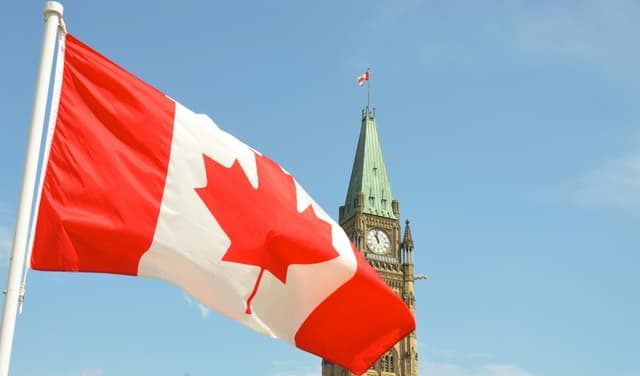
Entertainment Visualizer | Github Repository
Lauriault visualizes the local entertainment landscape within Ottawa using public transportation, Google maps, and population census data.
Data Collection
Our study utilized three primary types of information to analyze the city's layout and services.
First, we used the 2021 Statistics Canada Census to determine population density, specifically focusing on small geographic units called Dissemination Areas.
Second, we gathered public transportation data by tracking the location, speed, and direction of every OC Transpo bus every minute for one week in early 2025, resulting in over two million data points.
Third, we identified 195 local entertainment venues, such as museums, theaters, and parks, using Google My Maps and then manually verified that these locations were active and open to the public.
To make this information easy to compare, we organized all the data into a grid of hexagons using a system called H3 indexing, which allowed us to see exactly where population and transportation levels did not match the available entertainment.
Tech Stack
Lauriault was built on a modern stack using React and TypeScript, with Vite handling the bundling to keep things fast and modular.
To handle the aspect of rendering millions of data points without crashing the browser, we used Deck GL and Loaders GL for WebGL-powered visuals. MapLibre was used for the base map and smooth zooming, while the spatial logic relies on Uber’s H3 library for hexagonal clustering.
We also used Python and Pandas to clean up the raw data and strip out any additional noise. To make the data look intuitive, we used Kernel Density Estimation (KDE) to turn raw coordinates into nice-looking heatmaps.
Project Link
Here you can explore the visualization tool yourself and filter through 6 different layers of data.
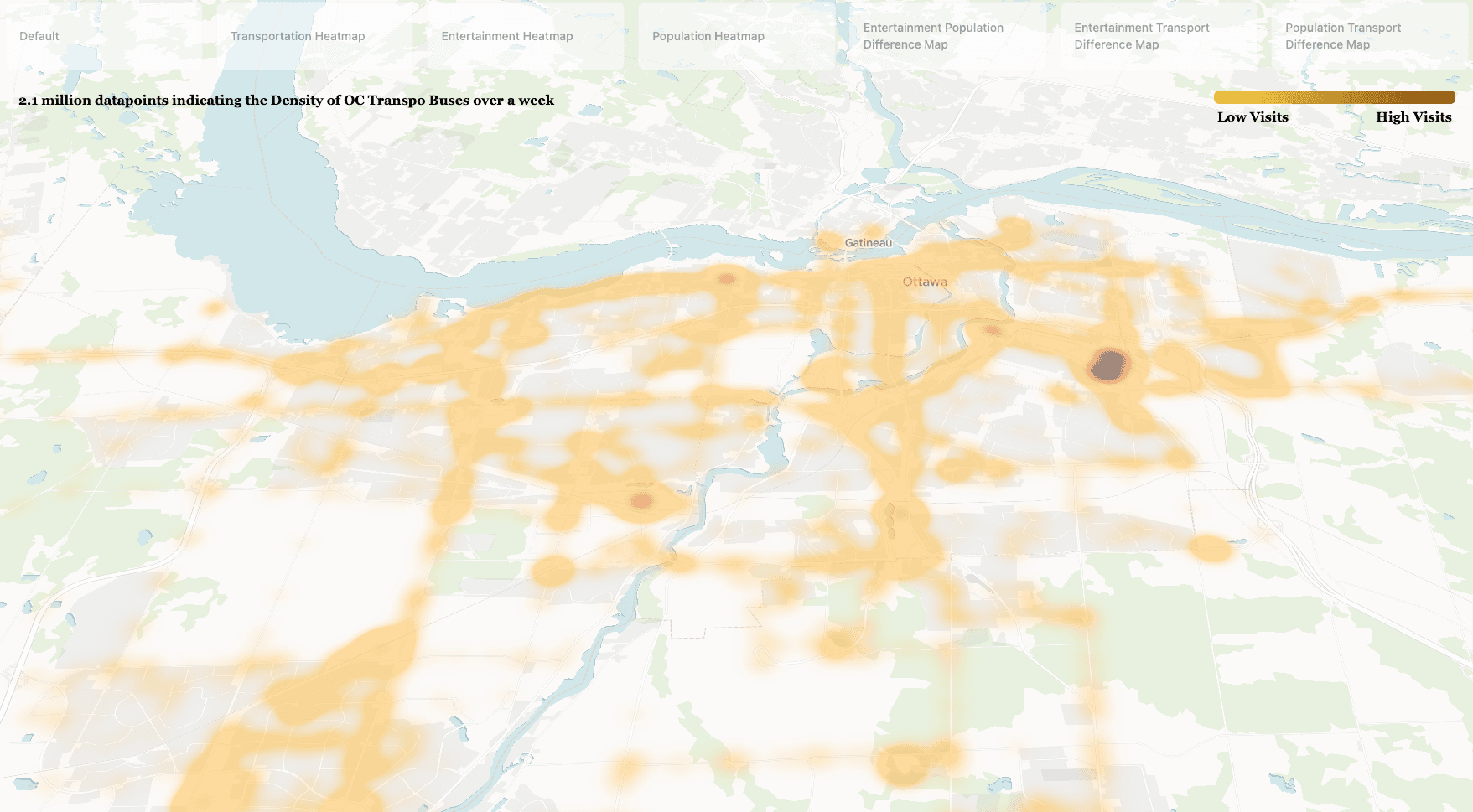
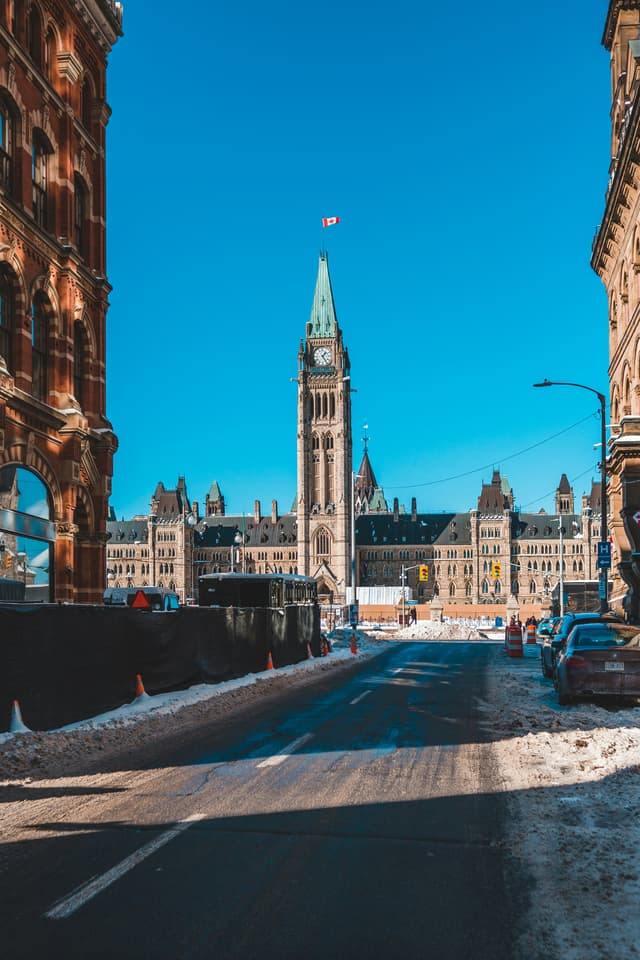
Lauriault | Ottawa Entertainment Visualization - Geospatial Data Analytics
Lauriault visualizes the local entertainment landscape within Ottawa using public transportation, Google maps, and population census data.
What isn't perfect
This project consists of three main issues. Firstly, our sentiment analysis relies on Reddit forum data, which definitely introduces bias and an over-representation of certain options (Voluntary Response Bias / Self Selection Bias).
Secondly, we categorized "entertainment" ourselves, which makes the dataset subjective and dependent on Google's classification; thus, it is possible we overlooked certain venues.
Finally, our project only looks at a small picture comprising 3 variables (transportation, population, and entertainment) and doesn't consider the true complexity of a city. This includes aspects such as zoning bylaws, federal land restrictions, environmental conservation initiatives, and many more. Thus, the creation of this project is just one piece of a large puzzle.
What is the meaning behind the project name?
I've written a post about the meaning behind my project names, you can read about it here.
Built with Next.js and Tailwind CSS. Made with ❤️ by Justin Zhang.